Stanley Park
An easy day, exactly when you need one.
If you're looking for an easy day with cycling, Stanley Park is a solid pick.
Not the pick for solitude or a rugged wilderness day.
Don't leave without...
- Walking
- Running
- Cycling
- Inline skating
- Fishing
Overview
Stanley Park is a 405-hectare (1,001-acre) public park in British Columbia, Canada, that makes up the northwestern half of Vancouver's Downtown peninsula, surrounded by waters of Burrard Inlet and English Bay. It is about one-fifth larger than New York City's Central Park and almost half the size of London's Richmond Park.
Quick Facts
- Type
- public park
- Coordinates
- 49.3000, -123.1400
Good to know
- Getting there & parking
Northwestern half of Vancouver's Downtown peninsula, surrounded by waters of Burrard Inlet and English Bay
Northwestern half of Vancouver's Downtown peninsula
- Facilities
- Playgrounds
- Sandy beaches
- Gardens
- Tennis courts
- 18-hole pitch and putt golf course
- Seaside swimming pool
- Water spray park
- Brockton Oval
- Rules
Monuments policy — The park board has banned the erection of any further memorials to ensure that Stanley Park is kept in a more natural state.
Exception to monuments policy — In 2006, the park board agreed to build a new playground at Ceperley Meadows near Second Beach honouring the victims of the Air India Flight 182 bombing.
More details
- Size
- 405-hectare (1,001-acre)
- Comparison
- About one-fifth larger than New York City's Central Park and almost half the size of London's Richmond Park.
- History
- The land was originally used by Indigenous peoples for thousands of years before British Columbia was colonized by the British during the 1858 Fraser Canyon Gold Rush.
- Opening
- Opened in September 1888 by Lord Stanley.
- Designation
- National Historic Site of Canada by the federal government in 1988.
- Attractions
- Vancouver Seawall, forest trails, beaches, lakes, children's play areas, and the Vancouver Aquarium.
- Recognition
- Named 'top park in the entire world' by Tripadvisor on June 18, 2014.
- Seawall length
- 22 kilometres (14 mi) from end to end, making it the world's longest uninterrupted waterfront walkway.
- Seawall construction
- Construction began in 1917 and took several decades to complete.
- Seawall extension
- The walkway was extended several times and, as of 2023, is 22 kilometres (14 mi) from end to end.
- Seawall activities
- Popular for walking, running, cycling, inline skating, and even fishing (with a licence).
- Seawall paths
- Two paths, one for skaters and cyclists and the other for pedestrians.
- Seawall loop
- Walking the entire loop around Stanley Park takes about two hours, while biking it takes about one hour.
- Forest trails
- More than 27 kilometres (17 mi) of forest trails inside the park.
- Forest trails patrol
- Patrolled by members of the Vancouver Police Department on horseback.
- Police department mounted unit
- Youth outreach includes offering guided tours of the stables and the 'Collector's Trading Card Program'.
- Stanley Park Railway
- 20 in (508 mm) narrow-gauge ridable miniature railway with different seasonal themes.
- Stanley Park Railway tradition
- A Vancouver tradition, especially for families with young children.
- Stanley Park Railway original
- Started in 1947, featured a child-sized train.
- Stanley Park Railway current
- Opened in 1964 in an area leveled by Typhoon Freda.
- Stanley Park Railway engine
- Replica of Canadian Pacific 374, the first transcontinental passenger train to arrive in Vancouver in the 1880s.
- Beaver Lake
- A restful space nestled among the trees, almost completely covered with water lilies.
- Beaver Lake surface area
- Just short of 4 hectares (10 acres) as of 1997.
- Beaver Lake connection
- Beaver Creek joins Beaver Lake to the Pacific Ocean.
- Lost Lagoon
- A 17-hectare (41-acre) freshwater lake near the Georgia Street entrance to the park.
- Lost Lagoon nesting ground
- Nesting ground to many bird species, such as Canada geese and ducks.
- Vancouver Aquarium
- The largest in Canada, houses a collection of marine life including sea lions, harbour seals, and sea otters.
- Vancouver Aquarium species
- Approximately 300 species of fish, 30,000 invertebrates, 56 species of amphibians and reptiles, and around 60 mammals and birds.
- Vancouver Aquarium theatre
- Home to a 4D theatre.
- 9 O'Clock Gun
- An 1816 naval cannon located near Brockton Point, fired for the first time in 1898.
- 9 O'Clock Gun tradition
- Fired for more than 100 years, originally detonated with a stick of dynamite but now activated automatically with an electronic trigger.
- Malkin Bowl
- An outdoor theatre featuring events by Theatre Under The Stars and Live Nation.
- Monuments
- Includes statues, plaques, and gardens, such as the Japanese Canadian War Memorial and statues of poet Robert Burns, Olympic runner Harry Jerome, and Girl in a Wetsuit.
- Great blue herons
- Home to one of the largest urban great blue heron colonies in North America.
- Great blue herons monitoring
- Monitored by the Stanley Park Ecology Society since 2004.
- Great blue herons fledged
- An estimated 156 young Pacific great blue herons fledged from the colony in 2013.
- Surroundings
- Burrard Inlet and English Bay
- Bordering neighborhoods
- West End and Coal Harbour
- Connection
- Lions Gate Bridge
- Historic lighthouse
- Brockton Point
- History
- Originally used by Indigenous peoples for thousands of years before British colonization
- Naming
- Named after Lord Stanley, 16th Earl of Derby
- Natural features
- Densely forested with about a half million trees, some as tall as 76 metres (249 ft)
- Windstorms
- Thousands of trees lost and replanted after three major windstorms in the past 100 years
- Vancouver Seawall
- Near-century-old, draws thousands of people in the summer
- Attractions
- Forest trails, beaches, lakes, children's play areas, Vancouver Aquarium
- Tripadvisor recognition
- Named 'top park in the entire world' on June 18, 2014
- Archaeological evidence
- Human presence dating back more than 3,000 years
- Traditional territory
- Multiple coastal Indigenous peoples
- Squamish Nation village
- Whoi Whoi, or X̱wáýx̱way
- Chaythoos
- Settlement further west along the shore
- Siwash Rock
- Landmark near present-day Third Beach
- European exploration
- First by Spanish captain José María Narváez (1791) and British captain George Vancouver (1792)
- Military reserve
- Surveyed and made a military reserve in 1863
- Leasing
- Vancouver City Council leased the park in 1886 for $1 per year
- National Historic Site
- Designated in 1988
- Recognition
- Named the best park in the world in 2013 by Tripadvisor's Travellers' Choice Awards
- Vancouver Seawall activities
- Walking, running, cycling, inline skating, fishing
- Forest trails
- More than 27 kilometres (17 mi) inside the park
- Stanley Park Railway
- 20 in (508 mm) narrow-gauge railway with different seasonal themes
- Beaver Lake
- Restful space with water lilies, beavers, fish, and water birds
- Lost Lagoon
- 17-hectare (41-acre) freshwater lake
- Vancouver Aquarium
- Largest in Canada, houses a collection of marine life
- 9 O'Clock Gun
- 1816 naval cannon located near Brockton Point
- Monuments
- Japanese Canadian War Memorial, statues of Robert Burns, Harry Jerome, and Girl in a Wetsuit
- Great blue herons
- One of the largest urban colonies in North America
- Connection
- Connected to the North Shore via the Lions Gate Bridge
- Historic lighthouse
- Located on Brockton Point, marks the park's easternmost point
- Naming
- Named after Lord Stanley, 16th Earl of Derby, a British politician
- Opening
- Opened by Lord Stanley in September 1888
- Windstorms
- Thousands of trees lost and replanted after three major windstorms in the past 100 years, the last in 2006
- Attractions
- Forest trails, beaches, lakes, children's play areas, and the Vancouver Aquarium
Keep Exploring
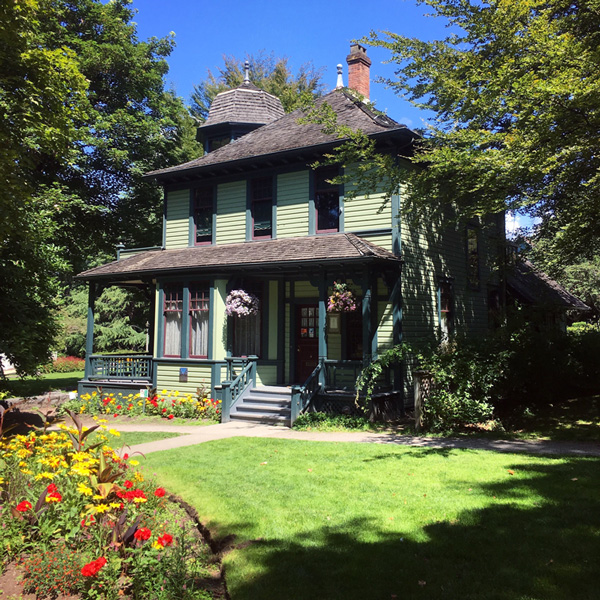
Roedde House
1.6 km away.
A restored 1893 home of Vancouver’s first bookbinder, reflecting the ambience of late-Vict…
Commodore Ballroom
2.6 km away.
A concert venue located at 868 Granville St., Vancouver, BC, V6Z 1K3.

Queen Elizabeth Theatre
3.0 km away.
A space designed to awe audiences and inspire performers, named for Queen Elizabeth II, wh…

Dr. Sun Yat-Sen Classical Chinese Garden
3.2 km away.
A registered museum and one of Vancouver’s top tourist attractions, offering cultural prog…

Rogers Arena
3.3 km away.
Rogers Arena is a multi-purpose arena located at 800 Griffiths Way in Downtown Vancouver,…
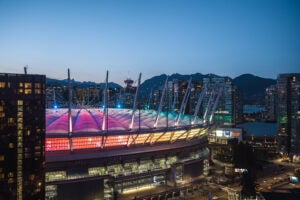
BC Place Stadium
3.4 km away.
A stadium in Vancouver that hosts sporting events, music events, conferences, trade shows,…
Vancouver Aquarium
660 m away.
The Vancouver Aquarium is located in the heart of Stanley Park in downtown Vancouver, Brit…
Vancouver Maritime Museum
2.6 km away.
A museum located in Vancouver, BC, offering exhibits on maritime history and culture.
Orpheum
2.6 km away.
A venue located at 601 Smithe St, Vancouver, BC, Canada, hosting events such as Bernstein'…
Kitsilano Beach
3.1 km away.
Kitsilano Beach is a beach on English Bay in the Kitsilano neighborhood of Vancouver, Brit…
Kitsilano Pool
3.2 km away.
Kitsilano Pool is the longest swimming pool in Canada, a salt-water outdoor pool located a…
Granville Island Public Market
3.3 km away.
A public market located on Granville Island in Vancouver, BC, featuring boutiques, food sh…